
Know what you own (2)
Part 2

As a continuation from my last post,

Here are more essential terms and concepts to help you make better financial decisions.
Contribution Terms
Contribution Limit: The maximum amount you can deposit into retirement accounts each year. For example, in 2025, an individual under 50 years old can contribute up to $23,500 to a 401(k) and up to $7,000 to an IRA.
Catch-up Contributions: Individuals aged 50 and above are eligible for additional contributions. For example, in 2025, an individual over 50 can contribute an additional $7,500 (totaling $31,000 for the year) for a 401 (k) and an extra $1,000 to an IRA (totaling $8,000 for the year).
Employer Match: When employers contribute additional funds in proportion to the employee's contributions. For example, Company X matches 100% of employee contributions up to 4% of salary, so an employee earning $60,000 who contributes $2,400 receives an additional $2,400 from the employer. Free money! Always contribute at least the company match percentage.
Vesting: The process by which a person gradually gains full ownership rights to an asset or benefit. These assets can be your employer match, stock options, or restricted stock units. Vesting occurs over a predetermined time or upon meeting specific conditions as follows:
Gradual Ownership: Rather than receiving full ownership immediately, rights to the asset are earned incrementally over time. You may be given 100 options that vest over a period of 4 years. Every year, you receive 25% of the options.
Cliff: Your shares are fully vested all at once after a specific period (e.g., 100% after 1 year).
Until assets are fully vested, you do not have rights to them. If you leave the company early, you forfeit all or a portion of the unvested portion of your compensation. Just so you know, while there may be a vesting schedule for company matches to a retirement plan, your contributions to a retirement plan are immediately vested.
Automatic Enrollment: When employers automatically sign up eligible employees for retirement plans. The contribution usually defaults to the matching level and a default investment. You can change the contribution and the investment type at any time.
Elective Deferral: Employee's voluntary contribution amount withheld from their paychecks (deferred) and deposited into their retirement plan. The company’s retirement plan provider typically has a portal where you can adjust the amount you want to defer (or contribute).
Distribution & Withdrawal Terms
RMD (Required Minimum Distribution): Mandatory withdrawals from certain retirement accounts (Traditional, SEP, SIMPLE IRAs, 401(k), 403(b), 457, and profit-sharing plans) starting at specific ages defined by the IRS, usually around age 73.
Early Withdrawal Penalty: Tax penalty (typically 10%) for withdrawing funds before age 59½ from some retirement plans (i.e., IRAs, 401(k), and other plans). These rules vary depending on the type of plan, so be sure to review your plan carefully before withdrawing money early. For traditional IRAs, you can avoid the penalty for various withdrawal reasons, including first-time home purchase, educational expenses, disability, unreimbursed medical expenses, and adoption fees.
Qualified Distribution: Withdrawals that satisfy IRS requirements and avoid penalties.
Hardship Withdrawal: Taking funds from retirement accounts early due to immediate financial need, and for example, following major medical expenses, disaster recovery, health insurance premiums if unemployed, etc.
Withdrawal Rate: Percentage of retirement savings withdrawn annually. Following the "4% rule," a retiree with $1 million withdraws $40,000 in the first year of retirement, adjusting for inflation in subsequent years. If inflation were 3%, year two would be $41,200, and year three would be $42,436.
Tax Concepts
Tax-Deferred Contributions: Postponing taxes until withdrawal in retirement. Traditional 401(k)s are tax-deferred; your contribution is deductible, reducing your current taxable income, but you will pay ordinary income taxes when you withdraw these funds in retirement.
After-Tax Contributions: Money contributed that has already been taxed.
Tax-Exempt/Tax-Free: No taxes owed on qualified withdrawals. Roth IRAs are tax-exempt. Your contributions to a Roth IRA are not tax-deductible – you pay taxes up-front. However, when you withdraw from the Roth IRA during retirement, the withdrawals are entirely tax-free.
Backdoor Roth: Strategy to fund a Roth IRA when income exceeds direct contribution limits. You would make after-tax contributions to a traditional IRA and then convert it to a Roth IRA. If you are implementing this tactic, be aware of the "pro rata" rule.
Mega Backdoor Roth: Process using after-tax 401(k) contributions to fund a Roth account. Your employer must support in-plan Roth conversions and after-tax contributions to the 401(k). You contribute the pre-tax limit to the 401 (k), and then you continue to contribute to the 401(k) on an after-tax basis. The company triggers an in-plan Roth conversion of all the dollars contributed after tax. If you are implementing this tactic, be aware of the "pro rata" rule.
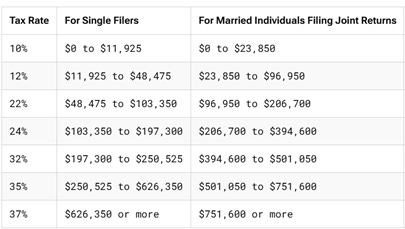
Tax Bracket: Income range subject to a specific tax rate. Below is a table for the 2025 tax brackets. In this example, a married couple with taxable income of $98,000 falls in the 22% federal tax bracket, but only their income above $96,950 is taxed at that rate. Income up to $23,850 is taxed at a 10% rate, and all income from $23,850 to $96,950 is taxed at a 12% rate.
This is getting long, I will add more in my next post.
Understanding what you own helps me make informed decisions about investing. Ultimately, you are the only one responsible for your financial decisions; take that responsibility seriously at all stages of your financial journey.