
Know what you own (3)
Part 3

A continuation from my last two posts,


Here are additional essential terms and concepts that will help you make more informed financial decisions through enhanced financial literacy.
Investment Options
Stock: A share in ownership (equity) of a company. If you own shares of a particular company, you are a shareholder, or a part-owner of the company.
Dividend Stock: Shares in companies that regularly distribute profits to shareholders instead of reinvesting in the company for growth. Realize that when a dividend is paid, the share price decreases by the dividend amount. Additionally, if the dividend is held in a taxable account, you will owe taxes on the dividend, regardless of whether you receive the cash or reinvest it.
Growth Stock: Shares in companies that tend not to have dividends and use their profits to reinvest in the company for growth. These companies may help their shareholders by repurchasing shares, thereby increasing the share price.
Bond: A debt obligation of a company or government. A bond is described by its key details:
Issuer (company or governing body that issued the bond)
Face Value (the amount paid for the bond, which is also called principal)
Coupon Rate (the interest rate paid to the bondholder)
Maturity date (the date when the principal is repaid).
For example, Company X has issued bonds with a face value of $10,000, a five-year maturity, and a 10% coupon rate. I purchased $10,000 worth of bonds from Company X. I will receive $1,000 (face value x coupon rate) annually for the next five years in interest, and at the end of the five-year term, I will receive my $10,000 principal back from the bond issuer.
Bond Fund: This is a portfolio of bonds designed to generate income, managed by a fund company. A bond fund is an alternative to buying individual bonds yourself. Instead, you would buy the fund, and the fund would be responsible for buying and selling the bonds.
Bond Ladder: A strategy of buying bonds with staggered maturity dates to provide a set amount of income over time. For example, you create a bond ladder by purchasing treasury bonds maturing in 1, 2, 3, 4, and 5 years. In year 1, you collect the interest from all the bonds and the principal from the year 1 bond; in year 2 you continue to earn interest for the remaining bonds and the principal of the year 2 bond, and so on until year 5 when you have collected the last of the interest and principal. As you collect the funds, you can reinvest in the ladder to extend its lifespan or utilize the income as planned.
Money Market Fund: A lower-risk investment option within retirement and brokerage accounts. It is a type of mutual fund that invests in very short-term, high-quality, and highly liquid debt instruments.
Mutual Fund: An investment portfolio managed by professionals. Mutual funds are traded once a day, at the end of the business day, and can be found in many retirement and brokerage accounts. These tend to be less tax-efficient than exchange-traded funds (ETFs).
ETF (Exchange-Traded Fund): An investment portfolio traded on stock exchanges like individual stocks. They are similar to mutual funds, but can be traded throughout the trading day. They tend to be more tax-efficient than mutual funds.
Index Mutual Fund (or ETF): A fund or ETF that invests in a particular market index, such as the S&P 500 (which tracks the 500 largest US companies by market capitalization), the Russell 2000 (which tracks the 200 smallest companies in the US), or the FTSE 100 (which tracks the top 100 stocks on the London Stock Exchange). These are not actively managed and tend to have a lower expense ratio than actively managed Mutual Funds or ETFs.
Target-Date Fund: An investment that automatically adjusts risk as retirement approaches. For example, a 2050 target-date fund will initially feature aggressive stock allocations and gradually become more conservative, increasing progressively its bond holdings as the 2050 target date approaches.
Actively Managed Mutual Fund (or ETF): A fund or ETF that has a portfolio manager who determines what investments to buy and sell. They will create their portfolio based on the fund's goal and their research. These tend to have a higher expense ratio than passive, index funds, or ETFs.
REIT (Real Estate Investment Trust): A fund that allows you to invest in income-producing real estate without buying and managing the properties yourself. The REIT will generate income from the collection of rents or mortgage interest and distribute a large portion of the revenue to its shareholders in the form of dividends.
Advanced Tax Concepts
Tax Loss Harvesting: Selling investments at a loss to offset capital gains. For example, you sell an underperforming stock for a $10,000 loss, which offsets $10,000 in capital gains from another well-performing investment, thereby reducing your tax liability.
Tax Gain Harvesting: When you are in a lower tax bracket, selling investments that have a gain to take advantage of the 0% or 15% capital gains tax and then repurchasing the stock, raising your cost basis on the stock. This lowers the tax implication when you sell it in the future.
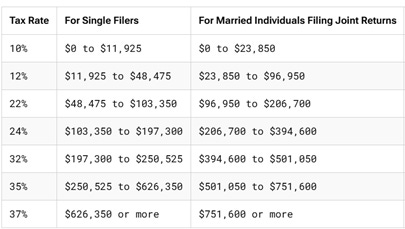
Tax Bracket: Income range subject to a specific federal tax rate. The table below shows the 2025 tax brackets. In this example, a married couple with taxable income of $98,000 falls in the 22% marginal tax bracket, but only their income above $96,950 is taxed at that rate. That is, their income up to $23,850 is taxed at a 10% rate, and all income from $23,850 to $96,950 is taxed at a 12% rate.
Cost Basis: The original investment amount used to calculate capital gains. If you were to buy $1,000 worth of shares for Stock X and sell them for $3,000, your cost basis would be $1,000, and your capital gain would be $2,000. Taxes are calculated on the gain; your cost basis is not included in the taxable amount.
Kiddie Tax: This tax rule applies to children who have unearned income, including interest, dividends, and capital gains. A portion of the unearned income is tax-free, and the remaining is taxed at the parents' tax bracket. A child is defined as an individual under the age of 19, or if a full-time student and not self-supporting, under the age of 24. For the 2025 tax year, the first $1,350 of a child's unearned income qualifies for the standard deduction (tax-free). The next $1,350 is taxed at the child's income tax rate, and any unearned income above $2,700 is taxed at the parent's marginal income tax rate.
Administrative Terms
Plan Administrator: The entity responsible for managing retirement plans. For example, Fidelity serves as the plan administrator for XYZ Corporation's 401(k) plan, handling record-keeping, compliance, and participant services.
Fiduciary: Person or entity legally obligated to act in your best interests. Stockbrokers, insurance salespeople, and most bank employees are not fiduciaries. It’s essential to ask any financial advisor you work with if they adhere to fiduciary standards.
Plan Document: Official document outlining retirement plan rules and provisions. These documents can be obtained from your HR team or the Plan administrator and include details on eligibility requirements, vesting schedules, distribution options, and how the plan operates. Please be careful, as this document can be complex and contains legal and financial terminology, for which you can use this glossary to help in deciphering.
Summary Plan Description (SPD): A simple explanation of a retirement plan provided to participants. This document is a summary of the plan description, typically outlining how the plan operates, key rights, and features in clear, plain language, free from legal jargon.
Contribution: Money added to an investment or retirement account. This money can be added through payroll deduction (for a 401(k)) or contributed directly (for a traditional or Roth IRA or brokerage account).
Rollover: Moving funds from one retirement account to another without tax or penalties. For example, when you change jobs, you can roll over your 401(k) balance to your new employer's 401(k) plan, maintaining tax-deferred status without triggering taxes or penalties.
Conversion: Changing assets from one tax treatment to another, typically Traditional (tax-deferred) to Roth (tax-free). In this instance, you will need to pay the taxes on the tax-deferred account to complete the conversion.
Beneficiary Designation: Documentation specifying who inherits account assets. The beneficiary designation takes precedence over your will; please review your beneficiaries annually and update them promptly whenever changes occur.
Fee Disclosure: Documentation of all costs associated with retirement plans. Please see my post <link here> for details on fees and disclosures.
Understanding what you own helps me make informed decisions about investing. Ultimately, you are the only one responsible for your financial decisions; take that responsibility seriously at all stages of your financial journey.